
 Barbara Tritz
If fluoride in drinking water is essential to preventing tooth decay, shouldn’t cavities reliably increase when it is removed?
For decades, the argument for community water fluoridation has sounded fairly simple: put fluoride into drinking water and tooth decay decreases. Remove it, and tooth decay should increase. So, I started asking what seemed like an obvious question: What actually happened in communities that stopped fluoridating their water?
Fortunately, this is not entirely hypothetical. Communities in Finland, Canada, Germany, Cuba, the Netherlands, and elsewhere have discontinued community water fluoridation and subsequently examined what happened to children’s teeth. The results are far more complicated and far more interesting than I expected.
In several communities, caries did not rise as predicted. In some, decay actually continued to decline after fluoridation stopped. Other results were mixed. And in Calgary, Canada, an important contemporary study found an increase in caries in children’s primary teeth after fluoridation ended. At first glance, those results may appear contradictory. I see them differently.
They tell us that dental caries is not controlled by one variable.
If removing fluoride produces different outcomes in different communities, perhaps we need to stop looking only at whether fluoride was present in the water and start examining everything else happening within that population—and within the mouth:
⭐ We Need to Look at the Terrain
This is the part I do not want us to skip.
If a child is developing decay, we need to investigate all of the conditions that may be driving that disease process. What are they eating? How frequently are they exposed to fermentable carbohydrates? What does the biofilm look like? How much saliva are they producing, and how well does that saliva buffer acids? Are they mouth breathing? Is reflux present? Are medications contributing to dry mouth? How effective is their home care? What is their access to preventive care? Are socioeconomic barriers influencing diet, dental visits, or treatment options?
These are not side notes. These are the clues that may lead us to the root causes.
Fluoride may alter how enamel responds to an acid challenge, but it does not remove the conditions creating that challenge. If we never investigate and address those conditions, fluoride risks becoming a bandage placed over a disease process that is still active underneath.
The goal should not simply be to make enamel more resistant to disease. The goal should be to discover why the disease is occurring, address the contributing factors, and change the terrain that allowed it to develop in the first place.
Finland: Fluoridation Stopped, but Caries Did Not Rebound
Kuopio, Finland began fluoridating its drinking water in 1959 and discontinued fluoridation at the end of 1992. Researchers compared children in Kuopio with children in nearby Jyväskylä, a low-fluoride community with reasonably similar demographic and socioeconomic characteristics. Children ages 6, 9, 12, and 15 were examined before cessation and again in 1995. The same calibrated dentists performed clinical and radiographic examinations in both communities.
What happened?
Researchers reported no indication of an increasing trend in caries in Kuopio after fluoridation stopped. In some of the older age groups, caries actually declined. Even more interesting, professional fluoride-varnish and sealant applications had also decreased sharply during the same period. That does not prove that fluoridation had never provided a benefit. Before cessation, some of the older children in fluoridated Kuopio had lower caries experience than children in the comparison city.
But when fluoridation stopped, the predicted rebound did not occur.
Why?
By the 1990s, these children were living in a very different dental environment from the one that existed when fluoridation began in 1959. Toothpaste, oral hygiene, preventive dentistry, education, xylitol use, access to dental care, dietary patterns, and numerous other factors were influencing caries risk. The water was only one piece of the terrain.
British Columbia: Another Unexpected Result
Researchers in British Columbia compared a community that had stopped fluoridating with another community that continued fluoridation.
Nearly 6,000 children were examined for caries prevalence, with almost 3,000 lifelong residents included in an incidence analysis. Over the three-year study period, caries prevalence decreased in the community that stopped fluoridating while remaining unchanged in the fluoridated comparison community. Overall incidence was not significantly different between the communities, although analyses of individual tooth surfaces and components of the caries index were more complicated.
Again, this does not prove that fluoride has no effect on caries. It demonstrates something more important for this discussion:
Removing fluoride from drinking water did not automatically produce a dramatic increase in decay.
Something else was influencing the outcome. More accurately, many things were influencing the outcome.
East Germany: Decay Continued to Fall
Researchers found another unexpected pattern after fluoridation ended in several communities in the former East Germany.
Instead of increasing, caries prevalence continued to decline. Among 12-year-olds, DMFT fell from 2.36 to 1.45 in Spremberg and from 2.47 to 1.96 in Zittau after fluoridation ceased. The investigators noted that the decline paralleled a broader national reduction in caries. They suggested that changing oral-health behaviors and the wider availability of preventive measures were likely contributing factors.
There is an important detail here. The same researchers believed their earlier data supported a benefit from water fluoridation before it stopped. So I do not think we should twist their findings into saying, “Fluoride never worked.” Their results tell us something much more interesting. Once fluoridation ended, caries did not necessarily reverse course.
The environment surrounding the disease had changed. The terrain had changed.
Cuba: Another Unexpected Outcome—with an Important Caveat
La Salud, Cuba discontinued water fluoridation in 1990.
Seven years later, researchers found that DMFT and DMFS remained low among younger children and decreased among several older groups. Among 12- and 13-year-olds, mean DMFT fell from 2.1 to 1.1, while the percentage of caries-free children increased.
But there is an important caveat, and I want to include it. Beginning in 1990, schoolchildren participated in a program using 0.2% sodium-fluoride mouth rinses approximately 15 times per year. The researchers themselves suggested that this could have contributed to the continued low caries levels.
So La Salud was not a fluoride-free population. And I am not including this finding as an endorsement of topical fluoride. It tells us something else: water fluoridation, toothpaste, mouth rinses, varnishes, gels, and other fluoride products represent different routes, doses, and frequencies of exposure. They should not automatically be treated as interchangeable.
I will return to the question of topical fluoride separately in the next article in this series.
And Then There Is Calgary-But the Story Is More Complicated Than the Headlines Suggested
Calgary, Alberta stopped fluoridating its municipal water in May 2011, while Edmonton continued fluoridation. Calgary is frequently cited as evidence that children’s cavities increased after fluoridation ended. But when I looked more closely at the actual timeline, the story became considerably more complicated.
The original study compared Grade 2 children examined in 2004/05 with children examined in 2013/14. Primary-tooth caries increased in both Calgary and Edmonton, with a larger increase in Calgary. The researchers concluded that the findings were consistent with an adverse short-term effect of fluoridation cessation.
But fluoridation did not stop until 2011.
That means the study did not measure a simple before-versus-after increase beginning when fluoride was removed. Most of the nine-year observation period occurred while Calgary was still fluoridated. McLaren herself later cautioned that reports claiming cavities suddenly “spiked” after cessation overstated what the study showed. The increase had been gradual across a period during which cessation occurred.
A 2017 peer-reviewed critique by Christopher Neurath and colleagues raised another important issue. Calgary had conducted an additional dental survey in 2009/10—approximately a year and a half before fluoridation ended. When that additional time point was considered, the authors argued that primary-tooth decay was already increasing before cessation and that the rate of increase did not clearly accelerate afterward. They also questioned whether differences between Calgary and Edmonton could adequately be separated from other caries-risk factors.
McLaren and colleagues responded that the 2009/10 survey lacked the tooth-surface information required for their particular surface-level analysis and cautioned that there was no comparable Edmonton survey from 2009/10. Nevertheless, they acknowledged the limitations of interpreting those three Calgary time points.
The permanent teeth make the early findings even more interesting. From 2004/05 to 2013/14, overall permanent-tooth caries actually decreased significantly in Calgary. When researchers narrowed the analysis to smooth surfaces among children who already had permanent-tooth decay, they observed a small trend in the opposite direction, but it was not statistically significant.
A later follow-up adds another layer. By 2018/19—seven to eight years after cessation—primary-tooth caries prevalence was higher in Calgary than Edmonton, and Calgary’s post-cessation trend was less favorable than Edmonton’s. The investigators interpreted those findings as consistent with an adverse effect of cessation. Yet even in that later study, Calgary’s post-cessation increase in primary-tooth caries prevalence was not statistically different from its pre-cessation increase. Permanent-tooth results remained less consistent.
Fluoride Does Not Correct the Terrain
Imagine a child who grazes throughout the day on crackers, fruit snacks, juice, sweetened beverages, or other fermentable carbohydrates. Perhaps that child sleeps with an open mouth. Salivary flow drops during sleep. Buffering capacity is poor. The oral environment remains acidic for prolonged periods. The biofilm becomes increasingly acidogenic. Maybe a medication contributes to dry mouth. Perhaps reflux introduces another acid challenge.
What has fluoride corrected?
- It has not changed the carbohydrate frequency.
- It has not restored salivary flow.
- It has not improved inadequate buffering.
- It has not closed the mouth during sleep.
- It has not diagnosed reflux.
- It has not corrected medication-induced xerostomia.
- It has not told us why the microbial ecology has shifted toward disease.
Fluoride may change the mineral response of enamel during an acid challenge. But the acid challenge continues.
That is why I describe fluoride, when it is used without investigating the disease process, as a bandage. A bandage may provide protection. But it does not explain why the wound keeps reopening. If the terrain is never changed, then we should not be surprised when another lesion develops, and then another.
I do not want dentistry trapped in an endless cycle of drill, fill, fluoride, repeat while never asking why disease continues.
We Have Known Something Important About Fluoride’s Mechanism for Decades
There is another piece of this puzzle that deserves attention.
In 1999, cariology researcher John Featherstone published an influential review titled Prevention and Reversal of Dental Caries: Role of Low Level Fluoride.
His description of dental caries itself is important. He described caries as a bacterially based disease driven by acids produced when bacteria metabolize fermentable carbohydrates and specifically identified acidogenic bacteria, salivary dysfunction, and dietary carbohydrates among the pathological factors involved in disease progression.
In other words, even in a classic fluoride paper, the disease was never simply a lack of fluoride.
Featherstone also concluded that fluoride’s caries-preventive effect works primarily through topical mechanisms—inhibiting demineralization and enhancing remineralization at the tooth surface, along with effects on bacterial enzymes. Importantly, he wrote:
“The effect of systemically ingested fluoride on caries is minimal.”
He further explained that the amount of fluoride incorporated into dental mineral through systemic ingestion was insufficient to play a significant role in preventing caries.
I want to be very clear about why I am including this. I am not using Featherstone’s work as an endorsement of fluoride toothpaste, varnish, rinses, or other topical fluoride products. That is a separate safety and risk-benefit question, and I will address it in Part V. I am including it because it challenges an idea many of us were taught: that children need to ingest fluoride so it can become incorporated into developing teeth and make those teeth inherently strong. The anticaries mechanism appears to be much more about what happens after the tooth erupts, at the interface of tooth, saliva, plaque, minerals, acids, and the surrounding oral environment. And once again, that brings us back to the terrain.
What Does Cochrane Say About Stopping Fluoridation?
The 2024 Cochrane review provides an important reality check.
When Cochrane looked specifically at fluoridation cessation, only one contemporary observational study involving 2,994 children met its criteria for the DMFS outcome. The evidence was rated very low certainty, and the reviewers concluded that there is insufficient evidence to determine the effect of stopping community water fluoridation on caries.
That does not mean cessation has been proven to have no effect. It also does not support saying that we know cavities will reliably skyrocket whenever fluoridation stops.
The contemporary evidence for starting fluoridation was also considerably less dramatic than the historical story many of us learned in school. In primary teeth, the estimated difference was approximately 0.24 fewer decayed, missing, or filled teeth per child, based on low-certainty evidence. The confidence interval included the possibility of no benefit. For permanent teeth, the contemporary evidence was considered very uncertain.
Cochrane’s authors specifically advised that decisions about beginning or ending water fluoridation be considered within the broader context of a population’s oral health, diet, water consumption, movement or migration, and availability and uptake of other caries-prevention strategies.
Read that again.
The broader context matters. The terrain matters.
Then I Looked Around the World
This is where the story becomes even more interesting.
Childhood caries declined dramatically across many industrialized nations during the second half of the twentieth century. It declined in countries with widespread community water fluoridation. And it declined in countries without national water-fluoridation programs.
WHO/FAO data illustrate just how dramatic these changes were. Among 12-year-olds, Australia fell from a mean DMFT of 9.3 in 1956 to 0.8 in 1998. The United States fell from 7.6 in 1946 to 1.4 in 1998.
But dramatic declines also occurred in countries that did not rely on widespread community water fluoridation. Finland fell from 7.5 in 1975 to 1.1 in 1997. Norway fell from 12.0 in 1940 to 1.5 in 1999. Switzerland fell from approximately 9.6 in the early 1960s to 0.8 in 1996. Japan also experienced a substantial decline. The WHO data therefore shows a broad international reduction in childhood caries across very different public-health systems and fluoride policies.
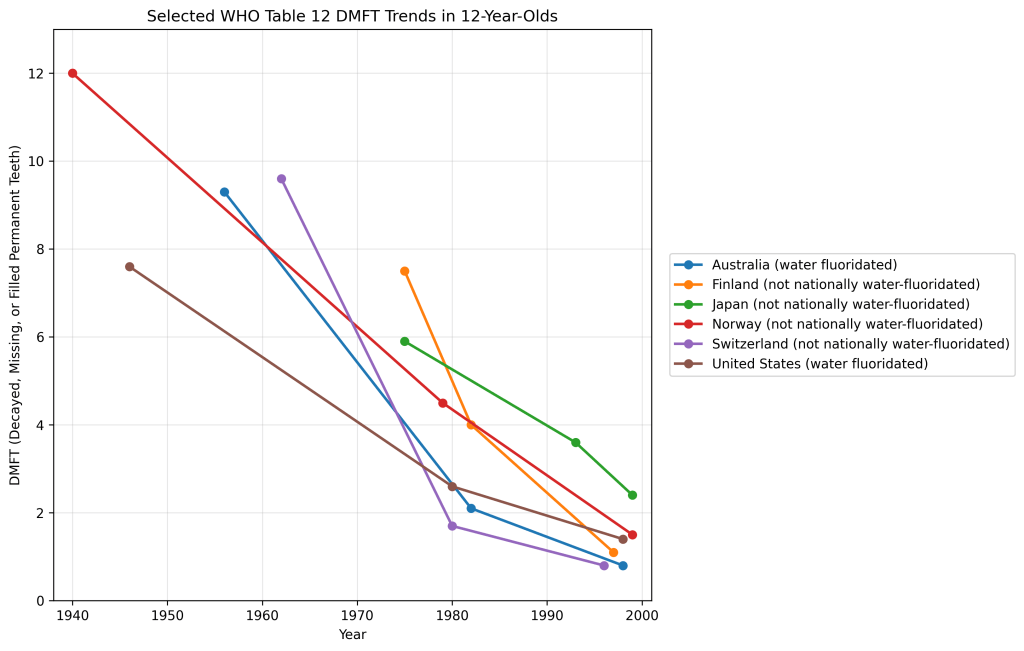
Graph Caption: Selected trends in dental caries among 12-year-olds using WHO/FAO DMFT data. Mean Decayed, Missing, or Filled Permanent Teeth (DMFT) declined substantially across the selected countries over time, including countries with widespread community water fluoridation and countries without national water-fluoridation programs. Fluoridation practices varied locally, and populations also differed in toothpaste use, diet, dental care, socioeconomic conditions, preventive programs, and other exposures. This descriptive graph illustrates population trends; it does not establish that fluoridation—or its absence—caused those trends. Source: WHO/FAO Technical Report Series 916, Table 12. Page 53 Graph created from the published data.
And look at the direction of those lines. They are going down. Not only in the United States. Not only in Australia. Not only in fluoridated populations. Dental caries declined across countries with very different approaches to fluoride exposure.
That graph does not prove that water fluoridation has no effect. International comparisons cannot establish causation. Countries differ enormously in diet, sugar frequency, toothpaste use, dental-care systems, socioeconomic conditions, preventive programs, diagnostic standards, culture, and numerous other variables.
But isn’t that exactly the point?
Dental caries is being influenced by far more than the fluoride concentration coming from the kitchen tap.
The Nordic Experience Gives Us Another Clue
A fascinating 2026 paper by respected cariology researchers Bente Nyvad and Ole Fejerskov examined roughly 50 years of population-level caries data from Nordic countries.
They describe a dramatic and sustained decline in caries and argue that these countries demonstrate that low population caries levels can be achieved without relying on systemic fluoride exposure. Their explanation emphasizes changes in oral-health practices and, in particular, widespread toothbrushing with fluoride toothpaste.
Again, I want to distinguish the researchers’ conclusion from my own position.
Nyvad and Fejerskov advocate fluoride toothpaste. I am not citing their paper as an endorsement of topical fluoride. I am citing it because Nordic countries achieved remarkably low caries levels without relying on community water fluoridation. Whether topical fluoride itself deserves additional scrutiny is a separate question and one I intend to examine next in Part V.
Maybe We Have Been Asking the Wrong Question
For me, the fluoride conversation has changed. I am no longer satisfied with asking: Does fluoride affect dental caries?
There is evidence that fluoride can influence demineralization and remineralization at the tooth surface.
The more important public-health question is: Does adding fluoride to everyone’s drinking water provide enough additional benefit in today’s world to justify population-wide systemic exposure?
And I think there is an equally important clinical question: Are we allowing fluoride to distract us from finding out why our patients are developing cavities?
- Why is the saliva inadequate?
- Why is the buffering poor?
- Why does oral pH remain low?
- Why has the biofilm become acidogenic?
- Why did someone who was cavity-free for 30 years suddenly begin developing new decay?
- What changed?
- A medication?
- Menopause?
- Hormonal changes?
- Mouth breathing?
- Reflux?
- Diet?
- Stress?
- Constant snacking?
- Hydration?
- Metabolic health?
- The microbiome?
- Why does one sibling develop rampant decay while another child eating at the same kitchen table does not?
These are the questions that move us from merely managing disease toward understanding disease.
The Terrain:Prevention Must Be Bigger Than Fluoride

Imagine what could happen if we put the same energy into understanding caries biology that we have put into debating fluoride.
We could teach parents about carbohydrate frequency and the Stephan curve. We could evaluate salivary quantity and quality. We could measure buffering capacity. We could identify dry mouth before rampant decay develops. We could address mouth breathing. We could recognize reflux. We could look more closely at the oral microbiome in high-risk patients. We could improve access to preventive dental care. We could help families understand how diet, saliva, breathing, biofilm, and behavior interact.
Most importantly, we could stop assuming that every patient with decay has the same disease drivers and therefore needs the same intervention.
If Calgary tells us caries can increase after fluoridation stops, then let’s understand why those children were vulnerable.
If Finland tells us caries does not inevitably rebound, let’s understand what protected those children.
If former East German communities experienced continuing declines after fluoridation ended, let’s study what changed.
And if Nordic populations can maintain exceptionally low levels of childhood decay without community water fluoridation, let’s learn from them too.
That is how science should work. We should not search only for studies that confirm what we already believe. We should ask why different populations give us different answers. Because the answer may lie not in a single mineral—but in the terrain surrounding the disease.
Dental caries is not a fluoride-deficiency disease.
It is a biological disease occurring within an ecological, behavioral, environmental, and social terrain.
If we only make enamel more resistant while leaving that terrain unchanged, we may make disease somewhat harder to express. We have not necessarily removed the reasons the disease developed. After more than four decades in dental hygiene, I no longer want to ask simply:
“Does this patient need more fluoride?” I want to ask: “Why is this patient developing decay?” Then I want to find the answer and address it.
Test. Teach. Treat. Repeat.
Stop guessing. Start testing.
Coming Next: Does “Topical” Really Mean Topical?
There is one more piece of the fluoride story that I think deserves its own examination. We routinely separate fluoride exposure into two categories: systemic fluoride and topical fluoride. But what happens when a young child swallows fluoride toothpaste? What happens to fluoride varnish after it sits in saliva? How much fluoride from toothpaste, rinses, gels, and professional treatments is swallowed or absorbed? And if fluoride applied “topically” can later be measured in blood or urine, how useful is that distinction when we are trying to understand total fluoride exposure?
That is where we are going next.
The Fluoride Question, Part V: “Topical” Does Not Mean Non-Systemic.
‘Til next week,
Warmly,
Barbara Tritz
Queen of Dental Hygiene
Change the terrain. Change outcome.
References
Featherstone JDB. Prevention and reversal of dental caries: role of low level fluoride. Community Dentistry and Oral Epidemiology. 1999;27(1):31–40. doi:10.1111/j.1600-0528.1999.tb01989.x. PubMed
Iheozor-Ejiofor Z, Walsh T, Lewis SR, et al. Water fluoridation for the prevention of dental caries. Cochrane Database of Systematic Reviews. 2024;10:CD010856. doi:10.1002/14651858.CD010856.pub3. Cochrane
Seppä L, Kärkkäinen S, Hausen H. Caries frequency in permanent teeth before and after discontinuation of water fluoridation in Kuopio, Finland. Community Dentistry and Oral Epidemiology. 1998;26(4):256–262. doi:10.1111/j.1600-0528.1998.tb01959.x. PubMed
Maupomé G, Clark DC, Levy SM, Berkowitz J. Patterns of dental caries following the cessation of water fluoridation. Community Dentistry and Oral Epidemiology. 2001;29(1):37–47. PubMed
Künzel W, Fischer T, Lorenz R, Brühmann S. Decline of caries prevalence after the cessation of water fluoridation in the former East Germany. Community Dentistry and Oral Epidemiology. 2000;28(5):382–389. doi:10.1034/j.1600-0528.2000.028005382.x. PubMed
Künzel W, Fischer T. Caries prevalence after cessation of water fluoridation in La Salud, Cuba. Caries Research. 2000;34(1):20–25. doi:10.1159/000016565. PubMed
McLaren L, Patterson SK, Faris P, et al. Fluoridation cessation and children’s dental caries: A 7-year follow-up evaluation of Grade 2 schoolchildren in Calgary and Edmonton, Canada. Community Dentistry and Oral Epidemiology. 2022;50(5):391–403. doi:10.1111/cdoe.12685. PubMed
World Health Organization/Food and Agriculture Organization. Diet, Nutrition and the Prevention of Chronic Diseases. WHO Technical Report Series 916. Geneva: WHO; 2003. Table 12: Trends in levels of dental caries in 12-year-olds.
Nyvad B, Fejerskov O. Remarkable decline and sustained low levels of caries in the Nordic populations—Explanations and implications for public oral health. European Journal of Oral Sciences. 2026;134(4):e70114. doi:10.1111/eos.70114. PubMed


0 Comments